
 April 7, 2026
A Practical Guide for Foreigners: How To Start a Business in Singapore?
Singapore is one of the most popular destinations for foreign entrepreneurs due to its position as a global launchpad for investment and innovation. It offers a unique combination of stability, opportunity, and connectivity that fuels both startup launches and long‑term expansion. This includes opportunities for growth and mobility that may be harder to find in your home countries, especially in the wake of global shifts like the pandemic.
For first‑time foreign entrepreneurs, the process might appear daunting and overwhelming. From understanding local director requirements and corporate service providers (CSPs) to navigating bank account setup and compliance filings, there are many moving parts to consider. Add in questions about startup costs and double taxation, and it’s clear that careful planning is essential.
This guide is designed to help foreign entrepreneurs navigate the process of starting a business in Singapore. From incorporation steps and compliance requirements to banking, visas, and relocation opportunities, you will find clear answers to the most common questions. By the end of this article, you should have a clear roadmap to launch your Singapore business confidently.
Can Foreigners Register a Company in Singapore?
The short answer is: Yes.
Singapore is one of the world’s most open and business‑friendly economies, allowing foreigners to incorporate a company with 100% foreign ownership and no requirement for local shareholding.
This combined with a low 17% corporate tax rate, a robust legal system, and an extensive network of over 90 Double Taxation Agreements, makes Singapore a preferred choice for entrepreneurs and multinational corporations seeking a regional headquarters.
As such, it remains one of the easiest Asia Pacific countries for foreigners to start and grow a business, thanks to its English‑speaking market, low corruption, efficient government, and vibrant international community.
Foreign entrepreneurs typically enter the market through three main routes:
-
- Operate Remotely with a Nominee Director: Oversee operations from abroad while appointing a resident nominee director in Singapore to meet statutory requirements.
- Form a Local Partnership: Collaborate with a Singaporean partner who assumes the role of resident director and handles day‑to‑day operations.
- Relocate to Direct Operations Personally: Those who want to be hands‑on can move to Singapore by securing an Employment Pass (EP) or EntrePass.
What is Required to Start a Business in Singapore?
For foreigners, starting a business in Singapore is streamlined but requires meeting several regulatory steps. When you register a company in Singapore, you have to follow the legal sequence mandated by Accounting and Corporate Regulatory Authority (ACRA). This ensures every business is properly structured, accountable, and transparent.
Foreigners cannot directly access the government’s BizFile system without a Singpass, which is Singapore’s secure digital identity system. So if you plan to operate remotely, the process always begins with engaging an ACRA‑registered Filing Agent (Corporate Service Provider) to handle incorporation.
Through the CSP, you’ll appoint at least one ordinarily resident director, a qualified company secretary within six months, and secure a registered local address. While co‑working spaces or virtual office services are acceptable, having a dedicated office can make banking smoother.
You will also need to issue shares and declare paid‑up capital. While the minimum is $1, it’s important to keep in mind that if you plan to apply for an Employment Pass (EP) later, the Ministry of Manpower usually expects about S$50,000–100,000 to demonstrate viability.
However, if you intend to relocate and manage operations locally, incorporation is still required, but you’ll also need to apply for an EP or EntrePass. These passes allow you to legally live in Singapore and run your company on the ground, while also enabling you to sponsor dependent passes for family members.
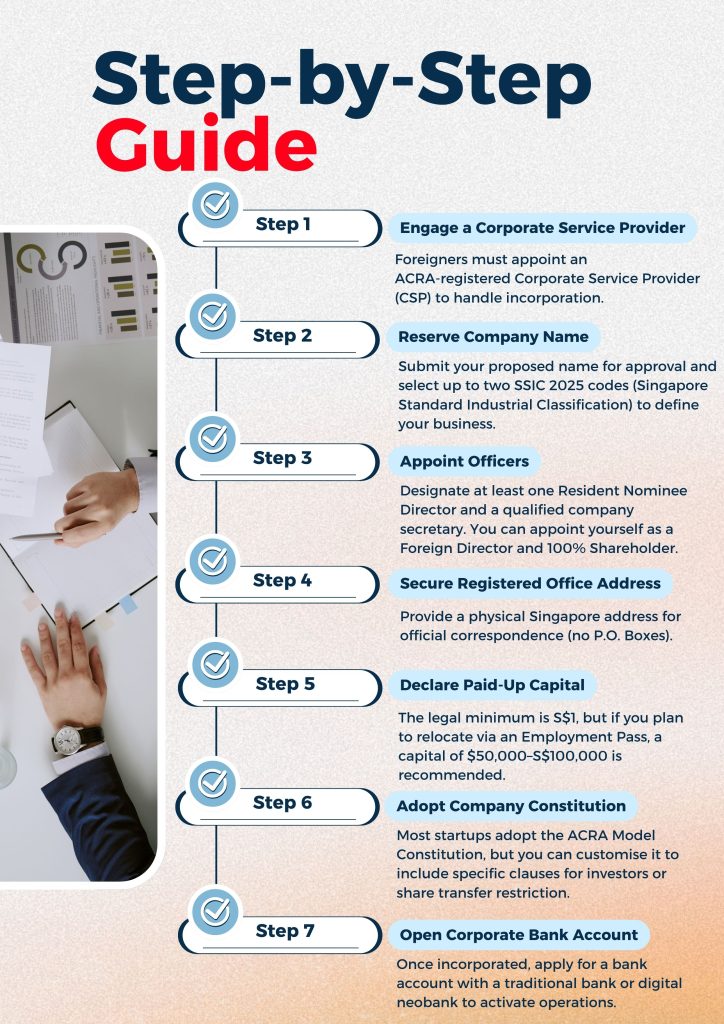
A Step-by-Step Guide for Foreigners
After engaging a Corporate Service Provider (CSP), the next major decision is choosing your business entity. Foreigners typically weigh options such as Sole Proprietorship, Limited Liability Partnership (LLP), Private Limited Company (Pte Ltd), or for established overseas firms, a Subsidiary, Branch Office, or Representative Office. Each carries distinct implications for liability exposure, tax treatment, and whether the structure supports a future relocation to Singapore.
Regardless of whether you intend to manage the business remotely or eventually relocate, the Private Limited (Pte Ltd) structure is the preferred choice for most founders. It offers limited liability protection, eligibility for startup tax exemptions, and the institutional credibility that banks and investors expect.
Once you’ve settled on your entity type, incorporation follows a clear sequence. Start by reserving your company name through ACRA, selecting up to two Singapore Standard Industrial Classification (SSIC) 2025 codes that define your primary business activity. Reserving your company name secures it for 120 days, during which you must complete the incorporation process.
As a foreigner, you must provide your incorporation documents to your CSP who will perform mandatory KYC (Know Your Customer) and AML (Anti‑Money Laundering) checks before lodging the application. This means preparing passport scans, proof of residential address, and a KYC questionnaire if you are an individual.
Next, you’ll finalise your incorporation by preparing the company constitution (most founders adopt ACRA’s Model Constitution), declaring paid‑up capital, and ensuring you have a registered Singapore address for official correspondence.
Alongside this, you have to appoint your officers: at least one Resident Nominee Director and a qualified company secretary, while you may simultaneously hold the roles of Foreign Director and 100% shareholder. With documents and officers in place, your CSP will submit the registration to ACRA on your behalf, since foreigners cannot file directly.
Upon approval, you’ll receive your incorporation documents, including your Unique Entity Number (UEN) and Certificate of Incorporation, which formally establish your company’s legal standing.
For foreign founders, incorporation in Singapore runs on two parallel tracks that work together: the visa track and the operations track. The visa track is about your legal right to work. At first you may rely on a nominee director, but once your EP or EntrePass is approved, you can step in as the resident director. The second is the operations track, which ensures your company can function financially. This means opening a corporate bank account, depositing your paid‑up capital, and using it to handle salaries and client payments. Both these tracks are interdependent: the bank account demonstrates funding needed for your visa application, while the visa allows you to take full control of the company.
With incorporation complete, the focus shifts to maintenance: meeting annual compliance deadlines for filings and tax obligations.
You can also refer to GoBusiness e‑Adviser to help you in this process. You can think of it as a digital concierge that guides you through the complex regulatory landscape with a questionnaire. This e-Adviser is most useful for foreign founders who are confused about selecting the correct SSIC 2025 codes for their business activities or those who want a clear, step-by-step path to market entry.
FAQs
1. How much does it cost to start and maintain a business in Singapore?
Starting a business in Singapore as a foreigner involves several upfront and recurring costs that you should budget for. You will need about S$315 for government fees (S$15 for name reservation and S$300 for registration). On top of that, you’ll need to pay a Filing Agent between S$500–S$1,500 to handle incorporation.
Since every company must have a local resident director, foreigners usually appoint a Nominee Director, which could cost about S$2,000–S$5,000 annually. You must also appoint a Corporate Secretary within six months, which could range from S$300–S$1,000 per year, and maintain a registered Singapore address for official correspondence, typically S$150–S$500 annually for a virtual office.
Altogether, the initial budget ranges from about S$3,300 to S$8,000.
2. Do I need to engage a Corporate Service Provider (CSP)?
Yes, CSPs are legally required for foreigners because they act as government‑approved gatekeepers to Singapore’s regulatory system. They verify your identity, proof of address, and source of wealth to meet strict KYC and AML standards, and they provide essential local services such as a company secretary, registered office address, and annual compliance filings. Only licensed CSPs, registered as Registered Filing Agents (RFAs) with ACRA, are authorised to file on behalf of foreign founders. Without them, you cannot legally incorporate or maintain a company in Singapore.
3. Why is a nominee director required?
In Singapore, the requirement for a Nominee Director is a strict legal mandate under the Companies Act. Every company must have at least one director who is “ordinarily resident” in Singapore i.e., they are a Singapore citizen, permanent resident, or a valid Employment Pass/EntrePass holder with a local address.
4. Will I be taxed twice if I earn income in Singapore and my home country?
Singapore uses a territorial tax system and has over 90 double taxation agreements (DTAs). Here’s how it works: profits are taxed in Singapore at a flat corporate rate of 17%. When those profits are paid out as dividends, Singapore charges 0% tax and does not impose withholding tax. Most countries with a DTA recognise the tax already paid in Singapore, so they either exempt the dividend income or give you a tax credit to offset local taxes.
The main issue is if you pay yourself a salary while living abroad. Singapore will not tax it, but your home country might treat it as personal income at its own rates. As such, many remote founders keep salaries minimal and take most earnings as dividends. To be safe, always check whether your home country has a tax treaty with Singapore, as this determines how credits or exemptions apply.
For United States citizens and Green Card holders, the Internal Revenue Service (IRS) applies worldwide taxation, which means you must report and pay U.S. tax on all income, even if earned in Singapore. This includes salaries, company profits, and dividends. Importantly, there is no income tax treaty between the United States and Singapore, so you cannot rely on treaty protection to avoid double taxation.
5. What annual filings are required?
As a foreign founder with a Singapore company, you must meet the same annual compliance obligations as any local business. The three key filings are:
-
- Annual General Meeting (AGM): Present financial statements to shareholders within 6 months of your financial year end (FYE), which can be done virtually or by written resolution.
- Annual Return (AR) with ACRA: File within 7 months of your FYE, confirming company details (directors, secretary, address, shareholding) and submitting financial statements
- Corporate Tax Returns with Inland Revenue Authority of Singapore (IRAS):
- Estimated Chargeable Income (ECI): Within 3 months of FYE (unless exempt)
- Form C‑S/C: Final tax return due by 30 November of the following year
Missing these deadlines can lead to fines, penalties, or even legal action against your nominee director. Even if your company is dormant, you must still file an Annual Return. Typically, your CSP manages these filings, but you remain responsible for providing documents and signatures on time.
Conclusion: Ready to Launch Your Singapore Business?
Singapore continues to hold its position as one of the world’s most compelling destinations for foreign founders. The regulatory clarity, tax efficiency, and CSP infrastructure exist precisely to lower the barrier for global entrepreneurs.
The mechanics are straightforward once you understand them but the real work is in the planning: choosing the right entity, aligning your visa strategy with your operational timeline, and building compliance habits from day one.
With the essentials in place, Singapore offers a strong launchpad for growth. To avoid costly missteps, check out our companion article on the 7 common mistakes foreign founders make when setting up a business. You can also refer directly to the Economic Development Board (EDB) or GoBusiness webpages, which provides more information and resources for entrepreneurs.